

Collagen Types Explained for Joint Care
Ever wondered what holds your body together? A huge part of the answer is collagen. It is the most abundant protein in your body, acting as the primary building block for your skin, muscles, bones, tendons, and ligaments. When it comes to joint health, collagen is your best friend, providing the structural support and cushioning that allows you to move with comfort and ease.
But not all collagen is the same. Different types of collagen have different jobs. For joint care, three types stand out: Type I, Type II, and Type III. Understanding what they do, how they work, and how to take them can make a real difference to your joint health and flexibility. Let's look at what the science says.
The Three Key Collagen Types for Joints
Your body contains many types of collagen, but for joint and connective tissue health, we focus on Types I, II, and III. Each has a unique role in maintaining the integrity and function of your musculoskeletal system.
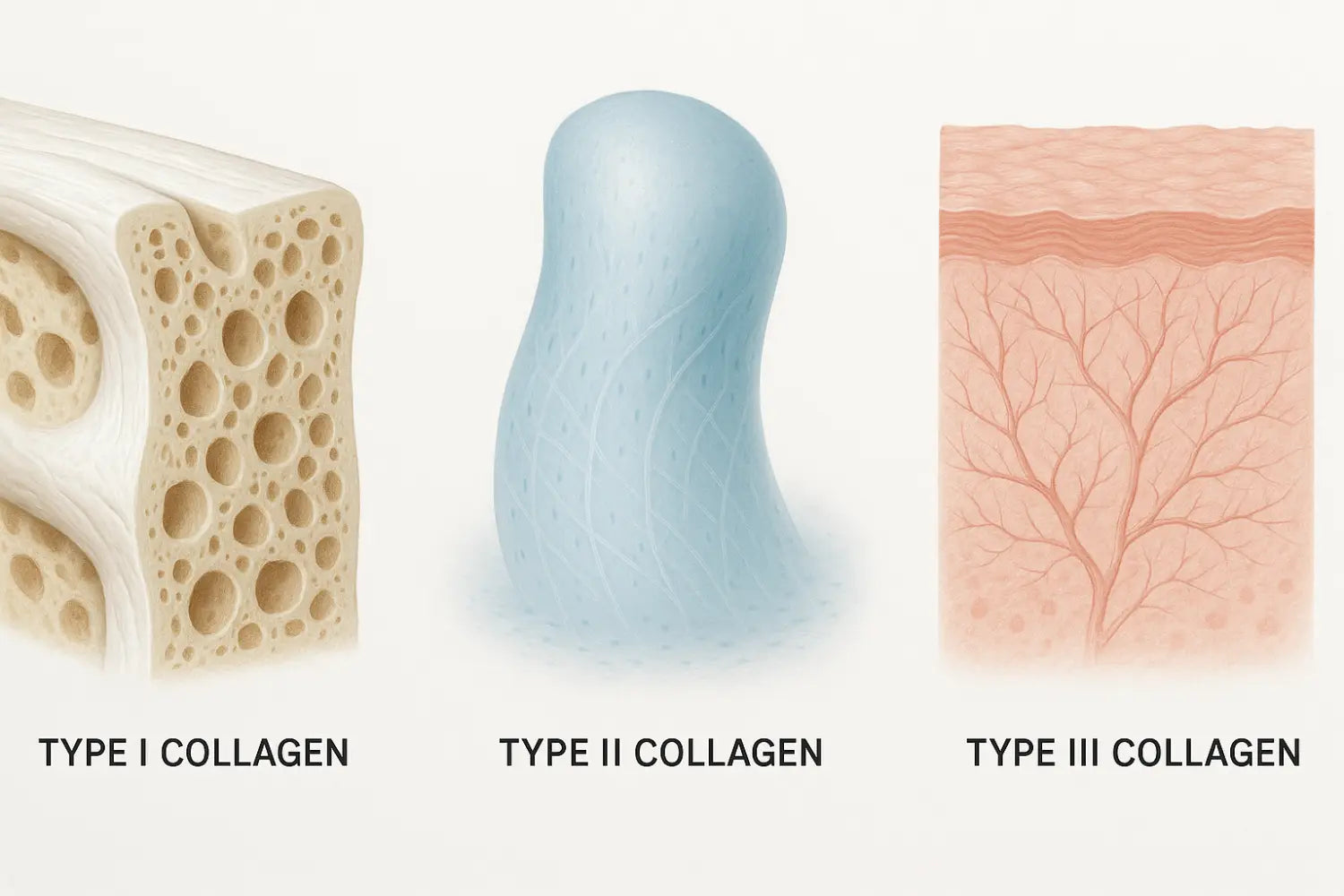
Type I Collagen: The Structural Foundation
Think of Type I collagen as the main scaffolding for your body. It is the most plentiful type, making up around 90% of your body's total collagen. It forms dense fibres that provide strength and structure to your bones, tendons, ligaments, and skin. In fact, Type I collagen accounts for over 90% of the organic matrix of your bones, giving them the resilience to withstand force. When you are looking to support the fundamental structures that surround your joints, Type I collagen is essential.
Type II Collagen: The Joint Cushion
Type II collagen is the star player when it comes to cartilage—the smooth, elastic tissue that covers the ends of your bones and allows your joints to move without friction. Around 90% to 95% of the collagen found in your articular cartilage is Type II. Its fine, dispersed fibres create a gel-like substance that provides cushioning and shock absorption. As the University of Leeds Histology Guide explains, this hyaline cartilage is crucial for joint function. Supporting your Type II collagen levels is key to maintaining healthy, comfortable joints.
Type III Collagen: The Supportive Mesh
Type III collagen is often found alongside Type I and plays a vital supporting role. It is a major component of your skin and blood vessels, forming a delicate meshwork of reticular fibres. While Type I provides the raw strength, Type III offers elasticity and support. It is also one of the first types of collagen to arrive on the scene during tissue repair, making it important for healing and maintaining the integrity of tissues throughout the body.
Forms of Collagen: What's Best for You?
Collagen supplements come in different forms, primarily hydrolysed and undenatured. The difference lies in how they are processed and how they work in your body.
Hydrolysed collagen, also known as collagen peptides, has been broken down into smaller, more easily absorbed amino acid chains. This high bioavailability means your body can readily use these peptides to build its own collagen where it is needed most, whether that is in your joints, bones, or skin. This is the form you will find in many powders and capsules, like those in our Joints & Flexibility supplements collection.
Undenatured Type II Collagen (UC-II) is a more specialised form. It is not broken down but remains in its native, three-dimensional structure. Instead of providing building blocks, UC-II works with your immune system through a process called oral tolerance. Research suggests that when UC-II is ingested, it interacts with immune cells in the gut, helping to prevent the body's own immune system from attacking the collagen in your joint cartilage. This can help reduce joint inflammation and promote cartilage repair.
The Power of Synergy: Collagen and Vitamin C
Taking a collagen supplement is a great step, but to get the most out of it, you need to ensure your body has enough vitamin C. Your body cannot produce collagen without it.

As the NHS website confirms, vitamin C is essential for maintaining healthy bones and cartilage. It acts as a crucial cofactor for the enzymes that stabilise and strengthen the collagen molecule. A systematic review in the Orthopaedic Journal of Sports Medicine found that vitamin C can accelerate bone healing and increase Type I collagen synthesis. Without enough vitamin C, your body simply cannot use the collagen you consume effectively.
Adults need around 40mg of vitamin C per day. You can get this from a balanced diet rich in citrus fruits, peppers, strawberries, and broccoli. Many high-quality supplements, such as our Easy-Move Collagen, include vitamin C for this very reason.
When to Take Collagen
There is no strict rule on the best time to take collagen. Some people prefer taking it on an empty stomach to maximise absorption, while others find it easier to mix into their morning coffee or a post-workout smoothie. The most important thing is consistency. Choose a time that works for you and stick with it to give your body a steady supply of the amino acids it needs for joint maintenance and repair.
The Takeaway
Supporting your joints is about more than just managing discomfort. It is about providing your body with the right building blocks to maintain a strong and resilient musculoskeletal system. By understanding the roles of Type I, II, and III collagen, choosing the right form for your needs, and ensuring you have enough vitamin C, you can give your joints the comprehensive support they deserve.
Ready to give your joints a helping hand? Explore our range of Joints & Flexibility supplements to find the right fit for your health goals.
Leave a comment